


Sequel Fatigue and Cinema's Inevitable Collapse
I don't know when you last went to the cinema, but I imagine that most of us, like me, haven't been for quite some time. As we know, the online world has long since made the concept of going to the cinema obsolete thanks to the convenience and affordability of watching films at home. However, the real reason lies in what is shown on the silver screen itself. Works that lack appeal and are captive to various forms of political propaganda no longer draw in large audiences as they once did. Clearly, the problem occurs not only at a personal level, but also at the production level.
Years ago, I briefly started reviewing films. Regarding the topic I mentioned, I realised that the problem had become widespread. In fact, I would comfortably say that the decline in quality is evident among films in cinemas, especially over the last ten years. However, I should mention that I am neither a film critic nor an academic.
As a result of these ongoing observations, I have categorised films in my mind. Some are good and have won the general audience's appreciation in one way or another. Conversely, bad films fall into their own subcategories, such as remakes and sequels. Now that I've finally got that off my chest, let's talk.
Out of curiosity, I quickly looked at some films from the last ten years that have received low ratings -they are not the top choice of their admirers-. Before long, I came across a few examples that illustrate my point.
First, let's take a look at their IMDb ratings and scores:
2016: Ben-Hur (rated 5.7 based on 49,000 votes)
In the history of world cinema, only three films have won 11 Oscars: the 2003 film The Lord of the Rings: The Return of the King, the 1997 film Titanic, and the 1959 film Ben-Hur. Yet they still felt the need to remake this film.
2017: Transformers: The Last Knight (rated 5.2 based on 184,000 votes)
As someone who has loved the Transformers series since childhood, I had never heard of this film before. It's a two-and-a-half-hour production. The first film was brilliant, though.
2018: Solo: A Star Wars Story (rated 6.9 based on 405,000 votes)
Han Solo is a well-known character in the Star Wars series. I remember there being a lot of hype for this two-hour-and-15-minute film made specifically about him. However, a few days later, I didn't hear much talk about it. It was quickly forgotten.
2019: X-Men: Dark Phoenix (rated 5.7 based on 225,000 votes)
I don't want to make excuses, but I didn't hear much about this film either. I've played the games and watched the cartoons based on all of these productions, but I think their abundance, coupled with the fact that they get lost among dozens of other films, explains why they're not more well-known.
2020: Wonder Woman 1984 (rated 5.3 based on 309,000 votes)
It was popular for a while and was advertised as a symbol of female bravery and strength (as if they needed that), but the hype quickly waned. I watched the first film at the cinema and thought it was average. After that, I didn't even feel like watching the sequels (however many there are).
2021: Space Jam: A New Legacy (rated 4.5 based on 86,000 votes)
Ah, Michael Jordan. The first film was a masterpiece. As children, we watched it in awe and wondered how they did it. Now it's barely worth mentioning.
2022: Lightyear (rated 6.1 based on 135,000 votes)
Which Lightyear? Buzz Lightyear. Woody's enemy-turned-friend from Toy Story. "If he was so beloved, why shouldn't he have his own film?" he joins the list of victims.
2023: The Marvels (rated 5.5 based on 160,000 votes)
Another heavily advertised film. However, it was one of the least liked films that year. Overblown campaigns still don't appeal to people, and the Marvel production team just didn't understand that. I won't even mention the cast. If we were to add another highly anticipated film to this year's list, it would be Indiana Jones and the Dial of Destiny, which received a 6.5 rating from 229,000 voters. It received an average rating of 6.5 from 229,000 votes. After all these years, Harrison Ford had decided to return, and everywhere it was announced that the film would be spectacular — but that's as far as it went.
2024: Joker: Folie à Deux (rated 5.2 based on 178,000 votes)
There's no need to comment on Joker. Its advertising campaign was as crazy as the character himself. News, comments and memes about the film were everywhere. In fact, the first film scored an impressive 8.3 points based on 1.7 million votes, taking the world by storm. But this Joker film had a tougher time. It ended up where it supposed to be and Lady Gaga, please don't push it any further. Hopefully, this obsession among singers to appear in one or two films will be short-lived. At least they should take supporting roles rather than trying to be lead actors.
2025: Snow White (rated 2.2 based on 393,000 votes)
Now comes the funny part! Last year's winner has arrived. It must be one of the worst films of all time. Why? Just listen to this: The main character, who is literally named “Snow White”, isn't actually Snow White. Those who bent over backwards to appease minorities got what they deserved. A 2.2 rating. While writing this, I noticed IMDb had added the laughable explanation “Our rating mechanism has detected unusual voting activity on this title.” They're clearly not accustomed to receiving tens of thousands of one-star ratings. Not to mention the great memes that emerged about it last year.
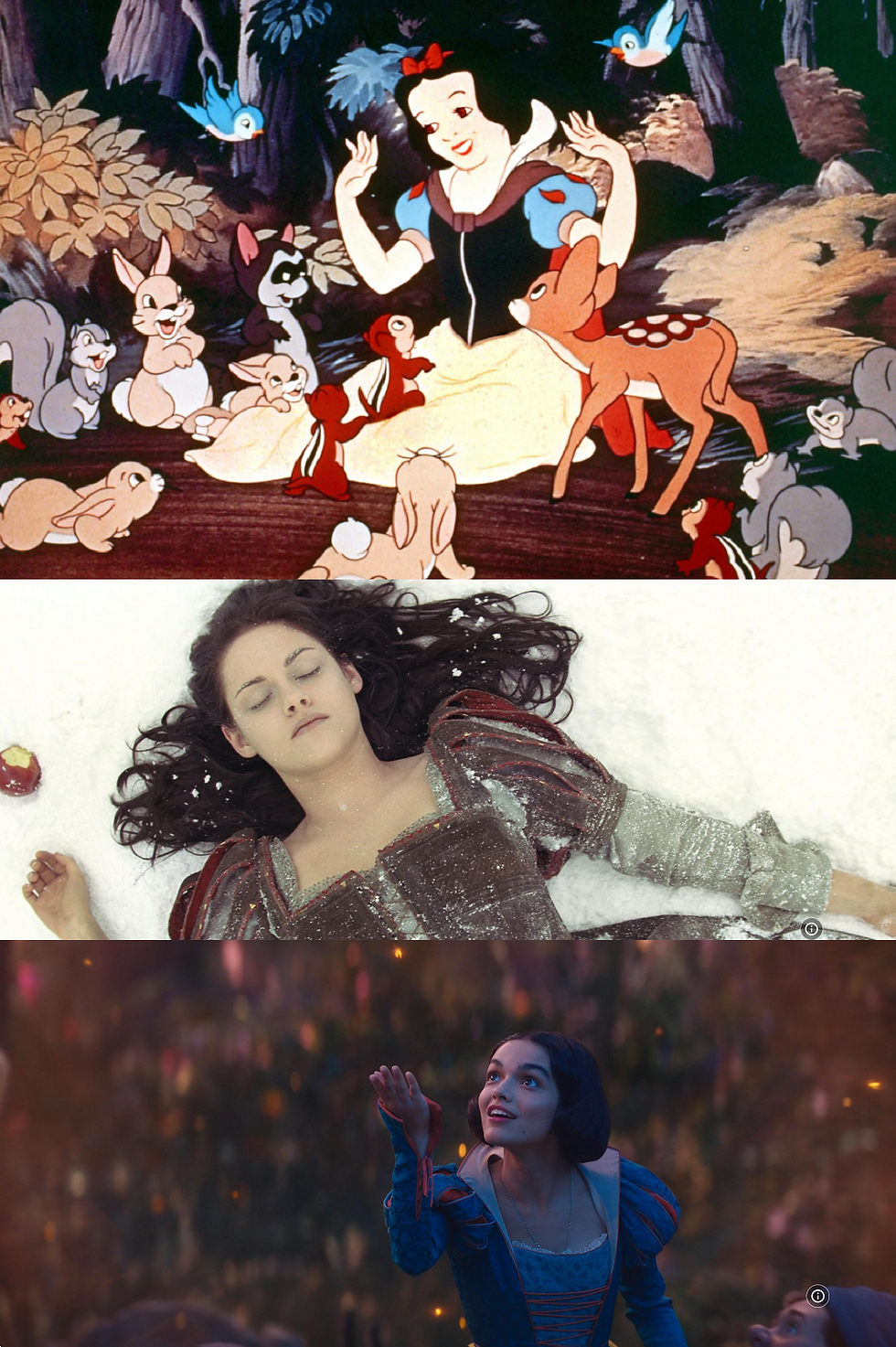
Snow White and the Seven Dwarfs (1937) (Source) - Snow White and the Huntsman (2012) (Source) - Snow White (2025) (Source) / An example of how cinema filters can be darkened and beautified. It's like ash is falling instead of snow.
So, let's talk about what's happening right now.
The film industry is in turmoil. As we said, people aren't going to the cinema for the reasons we mentioned earlier. They need to encourage people to go to the cinema, or at least, to watch the films being made. How will they achieve this? There are a few methods; I gave the above examples to illustrate this.
Focusing on successful franchises is at the top of the list. If a film is popular, a sequel is made such as Transformers, Wonder Woman, Joker and Gladiator
If a series already exists, it continues (e.g. Marvel films or Harry Potter sequels)
If the series has ended, special films are made about characters from the series (e.g. Han Solo, Buzz Lightyear and X-Men characters)
Thus, productions do not require more effort than usual because the brand, name and advertising are already in place. They are not designing something new, but continuing what already exists, just like a series. Is this bad? Not really. Alternative stories, whether remakes or sequels, can be intriguing. However, the fact that this has become the norm in the film industry clearly shows that profits are being prioritised over audience interests.
On the other hand, there are remakes. We started with a striking example: Ben-Hur. Can you imagine The Lord of the Rings trilogy being remade? You don't need to be a prophet to know that would be disastrous. They are trying to make a profit by adapting beloved productions that left sweet memories for their viewers and have now become cult classics for new generations — I emphasise this point — as well as adapting to new trends, such as various nonsensical ideological obsessions and whiny minorities. This is an even more blatant and tacky move than what we discussed earlier.
This is why Space Jam fails to capture the spirit of our childhood, and why Snow White resorts to foolish casting choices in an attempt to appeal to certain groups. Unfortunately, this happens all too often. As with most Hollywood films, there is a quota system in place to ensure the inclusion of actors of certain ethnicities, as you may have heard.
Disney has been around for a long time, but only occasionally produces something good nowadays. A similar situation occurred with the 2023 production of The Little Mermaid. Despite receiving 177,000 votes and a rating of 7.2, the same situation applies. “Our rating mechanism has detected unusual voting activity on this title. To preserve the reliability of our rating system, an alternate weighting calculation has been applied.” This is what happens when you turn the traditionally white character of Ariel completely black. Remember, producers with this mindset don't consider what you might like.

The Little Mermaid (1989) (Source) - The Little Mermaid (2023) (Source) - Ariel in the Little Mermaid: Songs from the Crystal Cavern (Source) / When the ecological balance is disrupted and the oceans become polluted, Ariel. So that was the message intended from the very beginning! Well done!
What does this year have in store for us on the big screen?
There are so many sequels that have caught my eye. Hopefully, among them, we will find films that are genuinely worth watching, rather than ones that have been made just for the sake of it. However, this does not change the reality of the situation. Some of the sequels I have read about that are due to be released this year include “Toy Story 5”, “Minions 3”, “Scary Movie 6” and “The Devil Wears Prada 2”. If you know of any other sequels or remakes being released this year, please share them in the comments.
We must all remember this: As individuals, we naturally expect the best in return for the services we pay for. If we cannot find what we're looking for in one place, we have the option to look elsewhere. This is our choice. However, monopolised sectors take this choice away from us, forcing us to accept the service on offer. The idea that the customer is king does not apply to such structures.
Monopolisation is barbaric, ruthless, immoral and hypocritical. Barbaric because civilisation requires competition for development. Ruthless because the personalities of those who do whatever is “necessary” to prevent others from doing the same job are questionable. Immoral because they deliberately make you accept them and then choose not to deliver what is desired. Hypocritical because the journey that begins with good intentions and slogans reveals the true nature of the person/institution.
For these reasons, the concept of conscious consumerism is back in the spotlight. Believe me, we don't have to watch every film. We always have the chance to choose. If we really want to, we can watch films on pirate sites. Don't worry, the producers and actors are getting paid. They don't think about us as much as we think about them. In fact, this is a form of advertising for them.
We should not hesitate to criticise productions that do not conform to our way of thinking or common sense. Of course, there's no need to argue with anyone while doing so. However, when that film is mentioned, we can tear it to shreds. Do we care about people who insult us? If not, then there is no reason why we should treat these companies' foolishness any differently. We can either ignore the positive reviews or criticise the film as much as we like. I will stop there, as discussing such films would take us into political territory, but those who are interested will already understand the underlying reason.

Photo by Venti Views on Unsplash

Photo by Romain Malaunay on Unsplash
In short, remakes and sequels are here to stay. Clearly, they will not offer the same experience. However, understanding their purpose enables us to become more discerning viewers. As the name suggests, remakes cannot exist independently of the original film. This can be seen in film adaptations. Provided they don't veer into the territory of absurdity we mentioned earlier, different formats can create an interesting alternative scenario. Sequels, on the other hand, are created to exploit your wallet if they have the same repetitive structure. Besides, films are not series; if we wanted series, we would watch them. Avoid productions driven by political concerns that change characters and feature casts deliberately selected to represent different races in a United Nations-like manner or give them a bad rating instead. As a viewer, this is the most effective way to make your voice heard. Most people look at reviews and ratings when they are not sure what to watch. You have the power to contribute to this.
What should ethical individuals within the industry do? If a director or producer laments the end of the cinema era, they should speak out in whatever way necessary to effect change within the film industry. They must put a stop to these absurdities. But in their money-driven world, this is far from easy.


Comments